
Power Your Feild with solar- Go Green With PM-KUSUM Yojana!
India’s largest and most trusted brand for the Kusum projects
PM KUSUM YOJANA
KUSUM Yojana is a government scheme that aims to help the farmers by bringing them under solar energy in agriculture. The scheme is said to provide financial pomoć to farmers for installation of solar pump sets and grid connected solar power plants, reducing their dependence on conventional fuels. Adopting solar solutions enables farmers to reduce electricity bills, open up new sources of income, and help in making environment green. The program is based on sustainable agriculture and rural energy infrastructure development in rural India. .
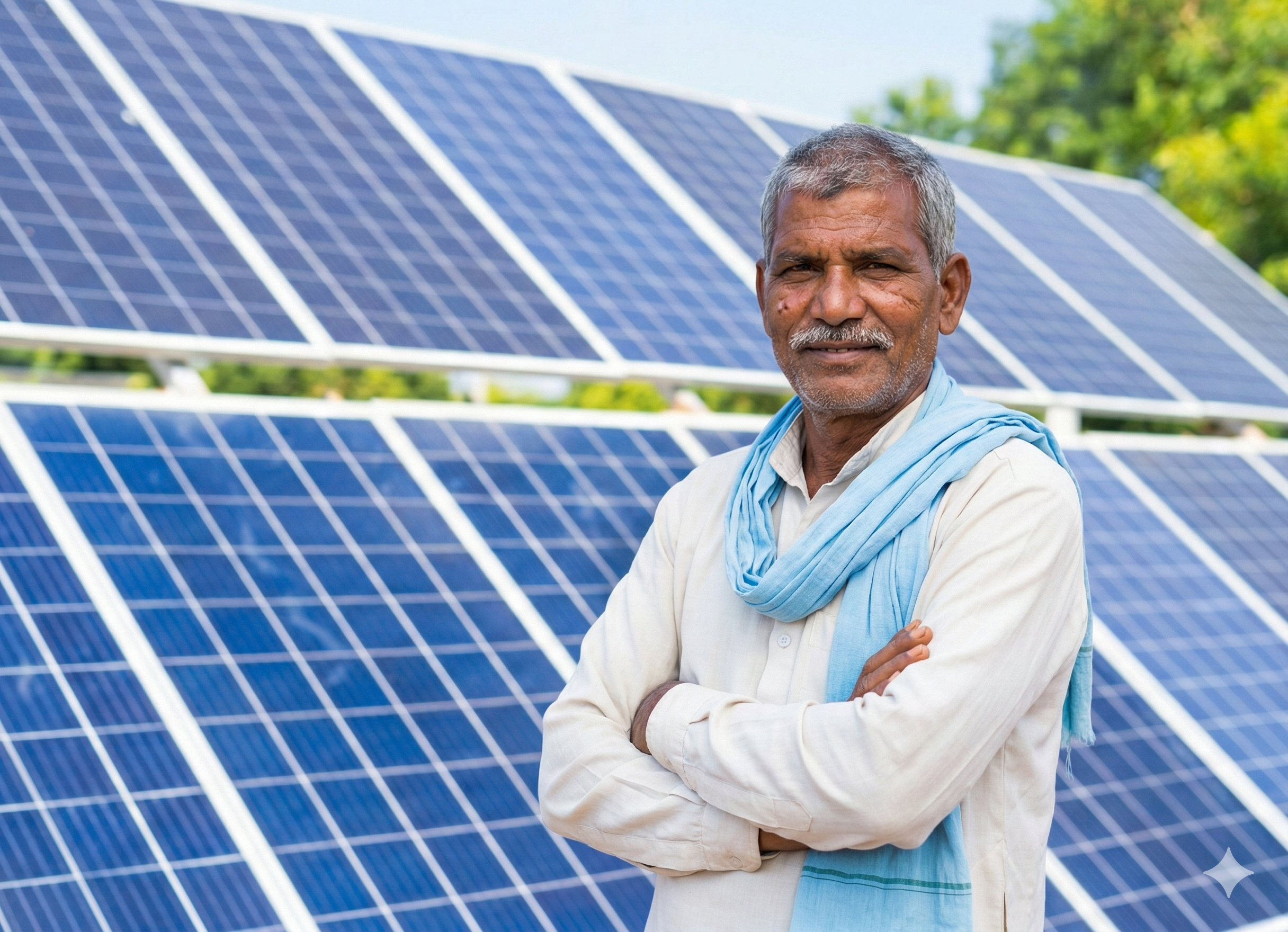
Pradhan Mantri KUSUM Yojana
A revolutionary scheme by the Ministry of New and Renewable Energy (MNRE) designed to ensure energy security for Indian farmers. Transform your unused, barren, or pasture land into a highly profitable, 25-year guaranteed income-generating asset backed by government agreements.
What is PM KUSUM Yojana? A Detailed Overview
Launched officially by the Government of India, the PM KUSUM (Pradhan Mantri Kisan Urja Suraksha evam Utthaan Mahabhiyan) scheme is a radical rethinking of power consumption and production in rural India. The farm sector has traditionally been plagued by unreliable supply of grid electricity, dependence on costly and heavily polluting diesel-powered generator sets and the financial burden of dealing with unproductive fallows.
PM KUSUM was formulated to solve all these issues simultaneously. The core objective is not just to "de-dieselize" the agricultural sector but to actively empower farmers by turning them from "power consumers" into "power producers" (Annadata to Urjadata). By installing solar infrastructure, farmers can secure reliable daytime power for their irrigation needs while creating an entirely new, recession-proof stream of regular income by selling surplus electricity back to the grid.
Under the scheme, either an individual farmer, panchayats or cooperatives can establish solar power plant on their fallow, waste or grazing lands. The power from these small plants is bought directly by local DISCOMs (Electricity Distribution Companies) at a predetermined and very attractive tariff approved by the respective State Electricity Regulatory Commission (SERC). Since this tariff is fixed in a legal contract of 25 years, your investment is fully protected against fluctuating market risks and inflation.
Eligibility: Who Can Benefit from This Scheme?
The government has kept the eligibility criteria broad to ensure maximum rural participation. The primary beneficiaries include:
- Individual Farmers: Any farmer owning barren, uncultivable, or agricultural land.
- Groups & Cooperatives: Group of farmers, Farmer Producer Organisations (FPOs), and Water User Associations (WUAs).
- Local Bodies: Gram Panchayats and rural institutional bodies looking to generate sustainable community funds.
- Developers (Lease Model): If a farmer does not have the capital to invest, they can lease their land to a solar developer for a fixed, mutually agreed-upon annual lease rent, creating a completely passive income stream.
The 3 Pillars of PM KUSUM
Component A (Decentralized Plants)
Establish decentralized, grid-connected solar power plants ranging from 500 kW to 2 MW on barren land. The electricity generated is sold directly to DISCOMs under a highly secure 25-year Power Purchase Agreement (PPA). This component offers the highest ROI for landowners.
Component B (Standalone Pumps)
Targeted at off-grid areas, this involves the installation of standalone solar-powered agricultural pumps (up to 7.5 HP) to replace diesel pumps. The government provides up to 30% CFA (Central Financial Assistance) and 30% State Subsidy, leaving the farmer to pay only a fraction of the cost.
Component C (Grid-connected Pumps)
Focuses on the solarization of existing grid-connected agricultural pumps. Farmers can meet their entire daytime farming power needs for free. More importantly, they can generate steady, long-term revenue by selling the surplus solar energy back to the state grid.
Land Requirements & Distance Constraints
Setting up a massive MW-scale solar project requires careful spatial planning. The following requirements must be met for the land to be considered to make the project technically feasible and financially viable:
- Land Area Needed: Setting up a solar power plant of 1 MW capacity requires continuous land in the tune of 4-5 acres. The terrain should be preferably flat so as not to incur excessive civil work for grading.
- Substation Proximity (Crucial): The proposed land must ideally be within a 5-kilometer radius of a 33/11 kV DISCOM substation. Being closer to the substation is critical because the farmer/developer has to bear the cost of laying the transmission lines. A shorter distance means lower capital expenditure (CAPEX) and reduced line losses during electricity transmission.
- Soil Quality: While barren land is preferred, solar plants can also be erected on cultivable land using a specific "stilt" mounting structure. This allows panels to be placed at a higher elevation, enabling farmers to continue cultivating low-height crops (like certain vegetables and medicinal plants) right beneath the solar panels, resulting in a dual-income model.
Bank Financing & Priority Sector Lending
A common concern for many applicants is the massive upfront capital required for Component A projects. The Reserve Bank of India (RBI) has categorized solar power projects under Priority Sector Lending (PSL). This means banks and financial institutions are mandated to provide easy credit facilities to eligible applicants.
Typically, banks will fund up to 70% to 80% of the total project cost. The applicant only needs to arrange the remaining 20% to 30% as "margin money". Furthermore, the guaranteed cash flows from the 25-year PPA act as solid collateral, making it significantly easier to secure these long-term loans at competitive interest rates.
Investment and Income Potential
Let's understand the financial potential with a highly realistic, practical example of a 1.2 MW Solar Power Plant under Component A.
Project Example: 1.2 MW Grid-Connected Plant
How It Works: The Application & Execution Journey
Initial Feasibility & Site Survey
The journey begins with our expert engineers physically visiting your land. We assess terrain suitability, measure the precise distance to the 33/11 kV substation, check grid evacuation capacity, and calculate your land's true generation potential.
Application & DPR Submission
We take the headache out of the paperwork. Our team files your application through the official State Nodal Agency (SNA) portal, submitting essential land documents along with a highly technical Detailed Project Report (DPR) tailored to your site.
Sanction & PPA Signing
After the nodal agency reviews and sanctions your application, a Letter of Award (LoA) is issued. We then guide you legally and administratively to sign the 25 years Power Purchase Agreement (PPA) with your respective state DISCOM.
EPC Installation & Commissioning
Our Tier-1 The EPC (Engineering, Procurement and Construction) team sources ultra-efficient solar modules, builds sturdy mounting systems, packages the inverters and effectively synchronizes the plant with the governmental power grid.
Frequently Asked Questions (FAQs)
1. Will I lose ownership of my land if I lease it out?
No way. Under the ground lease system, the developer is merely leasing the surface rights of the land to the user for a term of 25 years.Your title remains 100% in your name, and your rights are fully protected by a legally binding lease agreement. .
2. What happens if the solar panels get damaged?
Solar Panels With a Performance Warranty of 25 Years High quality solar panels come with a inbuilt performance warranty of 25years. Furthermore, the plant is fully insured against natural disasters along with theft or any unexpected damages. Our O&M ( Operations & Maintenance ) contracts make sure everything is running smoothly.
3. Why is distance to the substation so important?
Because the cost of setting up the transmission line from your plant to the DISCOM's substation is borne by the applicant. A distance greater than 5 kilometers makes the line-laying cost extremely high, which negatively impacts the overall ROI of the project.
Mandatory Documents Required for Application
To ensure a smooth, rejection-free application process, please keep the following verified documents ready:
- Identity Proof: Aadhaar Card, PAN Card, and recent passport-size photographs of the applicant.
- Land Records: Latest Jamabandi, Khasra, or Khatauni clearly indicating ownership.
- Financials: Bank Passbook or Cancelled Cheque for subsidy and DISCOM payment routing.
- Topography: Naksha Trace (Land map) certified by the local Patwari.
- Joint Consent: An NOC or Consent Letter signed by all parties if the land is jointly owned.
- Grid Feasibility: A formal distance certificate from the concerned DISCOM outlining distance to the 33/11kV Substation.
Ready to transform your land's financial future?
Setting up a MW scale solar plant involves heavy engineering, strict regulatory compliance, and complex documentation. Don't navigate this alone. Let Sakshine Solar's seasoned experts handle it from the very first site survey to the final grid connection.
Consult Our Experts Today