
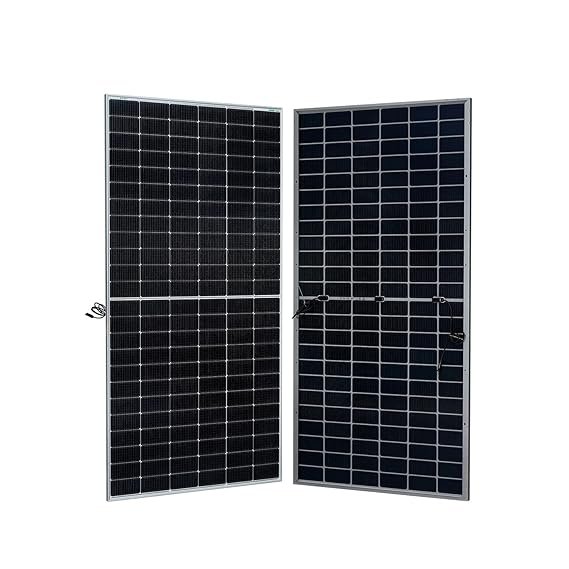
 Waaree bifacial solar module
Bifacial Solar Modules
Explore bifacial solar module options that can receive light on both the front and rear surfaces. Rear-side contribution depends on the exact module design, site reflectivity, mounting height, row spacing, shading and system layout. Review the manufacturer's datasheet and project design before selection.
Technical values are intentionally marked as pending until verified product data is supplied.
Designed to receive light from the front and rear.
Bifacial modules are designed to collect light on both module surfaces. The amount of rear-side irradiance available depends on the installation environment and system design, so additional energy yield must never be assumed from the module name alone.
Waaree bifacial solar module · product view
A bifacial module is designed to use sunlight reaching both its front and rear surfaces. The bifaciality factor describes the rear-side electrical response relative to the front-side response under the manufacturer's stated test conditions. It is not the same as a guaranteed project energy gain. Actual rear-side contribution depends on ground reflectivity (albedo), module elevation, tilt, row spacing, shading, nearby surfaces and system design.
Verify the module constructionGlass-glass or transparent backsheet, frame, junction box and rear-side design.
Review bifaciality dataManufacturer-stated bifaciality factor and the applicable test conditions.
Evaluate the installation environmentGround surface, clearance, mounting structure, row spacing and rear shading.
Review front-side ratings, bifaciality data, module construction and operating limits for the selected bifacial module.
All values below are placeholders and will be populated only from the exact manufacturer datasheet.
Electrical & performance data
Confirm front-side STC ratings and any manufacturer-published rear-side or bifacial performance data using the exact model datasheet.
Awaiting bifacial model datasheet| Rated maximum power (Pmax) | To be confirmed |
|---|---|
| Module efficiency | To be confirmed |
| Maximum power voltage (Vmp) | To be provided |
| Maximum power current (Imp) | To be provided |
| Open-circuit voltage (Voc) | To be provided |
| Short-circuit current (Isc) | To be provided |
| Power tolerance | To be confirmed |
| Bifaciality factor | To be confirmed |
| Rear-side power / current data (if published) | To be provided |
| Temperature coefficients (Pmax / Voc / Isc) | To be provided |
Front and rear-side construction
- Cell technology / format
- To be verified
- Cell count / configuration
- To be provided
- Front and rear surface material
- Glass-glass / transparent backsheet · verify
- Module dimensions & weight
- To be provided
- Frame, junction box & connectors
- To be provided
Operating limits and documentation
- Maximum system voltage / series fuse
- To be provided
- Operating temperature range
- To be provided
- Maximum design load / test load
- To be verified
- Certifications & test standards
- To be verified
- Product & performance warranty
- To be confirmed
i All electrical, bifaciality, mechanical, certification and warranty fields are placeholders. Verify every value against the exact module datasheet and current supporting documents.
What to evaluate when selecting a bifacial module.
These are selection considerations, not guaranteed performance claims. Confirm each feature on the exact manufacturer datasheet.
Front and rear-side response
Check the manufacturer's bifaciality factor and rear-side data under the stated test conditions.
Module construction
Confirm whether the exact model uses glass-glass or a transparent backsheet and review its mechanical design.
Installation geometry
Assess mounting height, tilt, row spacing, ground reflectivity and potential rear-side shading.
Warranty & certifications
Review the published product and performance warranty terms and applicable certificates.
Assess where rear-side light can reach the module.
Bifacial modules may be considered for project layouts where the rear surface can receive useful reflected or diffuse light. Suitability and any energy-yield estimate depend on site-specific modelling, mounting geometry, ground conditions, shading, structure and the exact module data.
Discuss your projectGround-mounted systems
Model ground reflectivity, module height, row spacing and rear-side shading.
Elevated rooftops & canopies
Check rear clearance, support geometry, reflected light and structural requirements.
Commercial solar projects
Assess site layout, surface material, operating environment and project-specific yield modelling.
View the front, rear and module construction.
Replace these spaces with approved product, installation and rear-side photographs for the exact model.
01 · Waaree bifacial solar moduleFrequently asked questions.
General bifacial-module information is provided here. Confirm product-specific characteristics using the official manufacturer datasheet.
Send your model or project question to the Sakshine Solar team.
Ask a question ↗What is a bifacial solar module?+
A bifacial module is designed to collect light on both its front and rear surfaces. The exact construction and electrical characteristics depend on the manufacturer and model.
Does a bifaciality factor equal extra energy yield?+
No. The bifaciality factor describes the rear-side electrical response relative to the front side under stated test conditions. Project energy gain also depends on site reflectivity, module elevation, tilt, row spacing, shading and system design.
What affects rear-side energy contribution?+
Ground reflectivity (albedo), mounting height, tilt, row spacing, nearby surfaces, obstructions and rear-side shading can all influence the light reaching the rear of the module.
Are all bifacial modules glass-glass?+
Not necessarily. Construction varies by model and may include glass-glass or a transparent backsheet design. Check the specific manufacturer's product documentation.
Can bifacial modules be installed on rooftops?
Suitability depends on rear-side clearance, roof surface, mounting structure, shading, wind and structural design. A project-specific engineering and yield assessment is recommended.
What specifications and warranty should I request?
Request the exact model datasheet, bifaciality factor and test conditions, STC ratings, mechanical load data, certificates, installation guidance and product/performance warranty documents.
Have a project in mind?
Tell us what you are planning. Our team can help you review product information and discuss the next steps.
i This page is a bifacial solar module information template. Replace all pending values and illustrative artwork with approved, model-specific manufacturer information before publishing.